
Case study · 01 — Stanford University Press
Designed to belong. Built to differ
One editorial system for Stanford University Press — each journal its own mark, one line through all of them.
- Client
- Stanford University Press
- Timeline
- 2025 — ongoing
- Disciplines
- Identity · Editorial · Technology
02 / 11 The brief
Five journals. One shared foundation.
Each journal has its own mark, colour and type. Underneath them sits one system — the same masthead and anatomy, carried from the identity to the PDF, the HTML article and the journal site.
01 / 04 · Identity
Identity. It starts with the tree.
The mark of Stanford University Press — the one constant at the right of every journal’s masthead.
02 / 04 · PDF
PDF. The article, typeset.
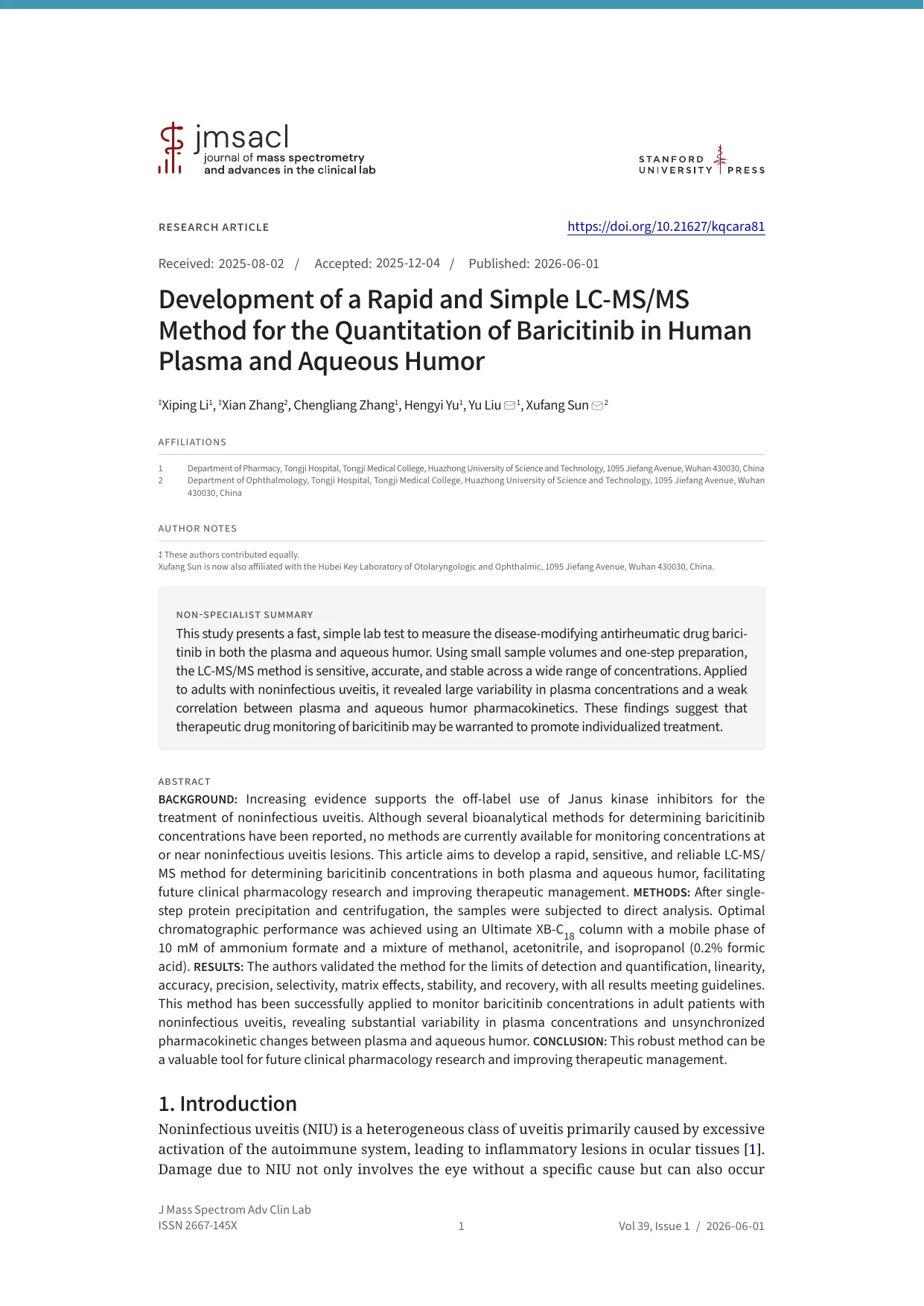
The JMSACL template: A4, one column, the journal’s band and mark at the top. This page is a published article.Published
03 / 04 · HTML
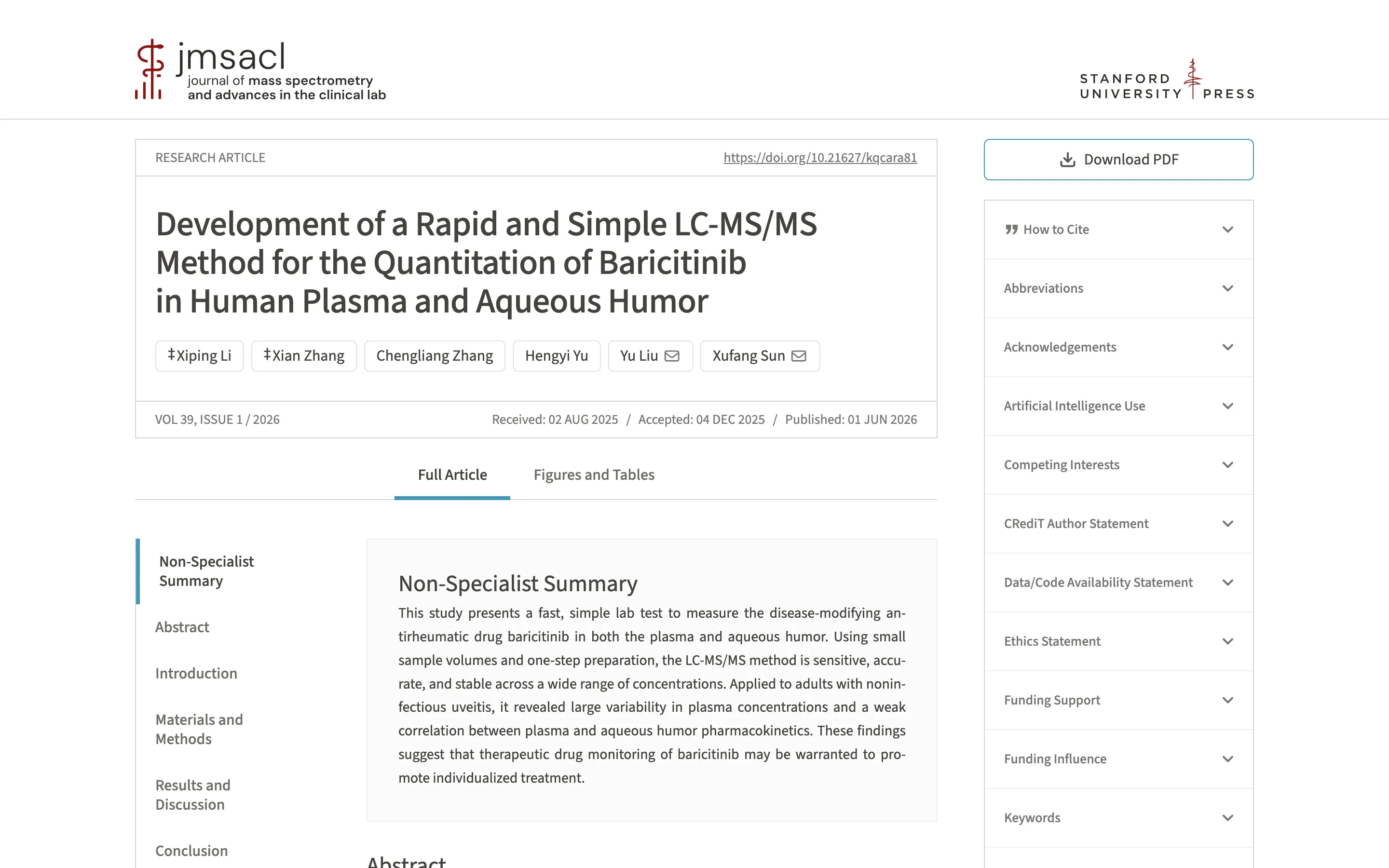
HTML. The same article, generated.
Our transformer reads the article’s JATS XML and sets it as an accessible web page in the journal’s design.Published
04 / 04 · OJS
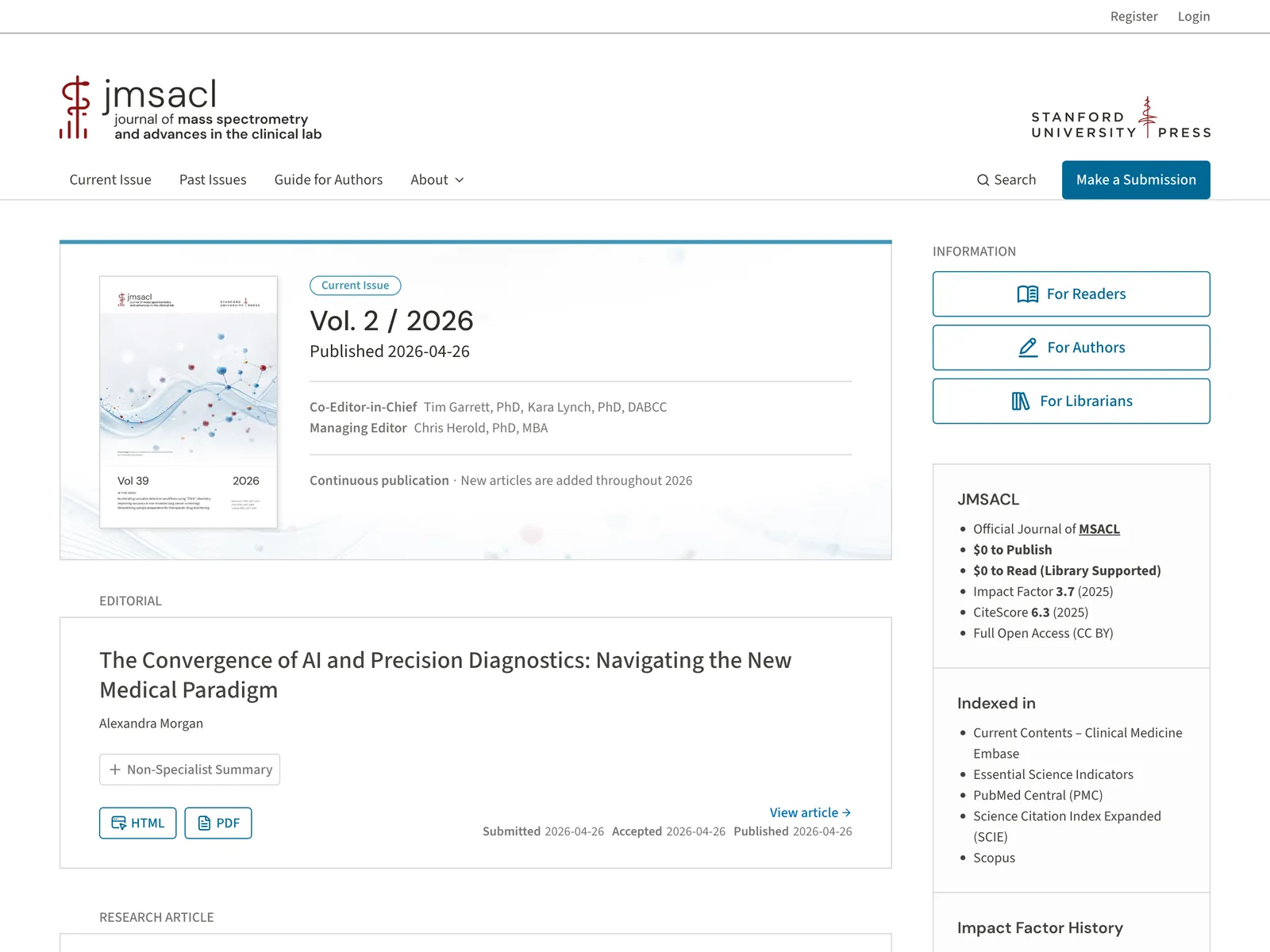
OJS. The journal, presented.
One theme for Open Journal Systems, set journal by journal from the back office. Shown on the staging server — not yet in production.Staging
One continuous system. From the mark to the platform.
Four expressions of one identity, each in its own medium, all on the same foundation.
01 / 04 · Identity
Identity. It starts with the tree.
The mark of Stanford University Press — the one constant at the right of every journal’s masthead.
02 / 04 · PDF
PDF. The article, typeset.
The JMSACL template: A4, one column, the journal’s band and mark at the top. This page is a published article.Published
03 / 04 · HTML
HTML. The same article, generated.
Our transformer reads the article’s JATS XML and sets it as an accessible web page in the journal’s design.Published

04 / 04 · OJS
OJS. The journal, presented.
One theme for Open Journal Systems, set journal by journal from the back office. Shown on the staging server — not yet in production.Staging
One continuous system. From the mark to the platform.
Four expressions of one identity, each in its own medium, all on the same foundation.
03 / 11 The marks
One rule for the family. A mark from each journal’s own field.
The symbol in Stanford red, the name in ink, the press at the right of every masthead. Inside that rule each journal gets a symbol drawn from its own field — and all of them read as Stanford University Press.
-
01 JMSACL — Clinical mass spectrometry
-
02 PBMT — Population biology
-
03 BIOG — Biogeography
-
04 AAT — Mathematics
-
05 SUP — The press
04 / 11 Colour
Five families from the Stanford identity. A journal picks a family, not a colour.
Each family resolves twenty-one roles — brand, hover, active, borders, tints, text, focus — so that a button, a link and a band behave the same way on every journal and pass contrast before they become a token.
SkyJMSACL
- Deep
#016895 - Brand
#4298B5 - Dark
#004869 - Tint
#E3F9FF
Palo VerdePBMT · BIOG
- Deep
#017E7C - Brand
#279989 - Dark
#005957 - Tint
#E2F4F0
IlluminatingREL
- Brand
#FEDD5C - Light
#FFE781 - Strong
#FEC51D - Tint
#FFF9E6
Palo Altoavailable
- Deep
#014240 - Brand
#175E54 - Dark
#012E2D - Tint
#E3ECEA
Lagunitaavailable
- Deep
#006B81 - Brand
#007C92 - Dark
#004B5A - Tint
#E0EFF2
Eleven more Stanford families were examined and left out: Plum, Brick and Archway because a pressed button could not be told from a resting one; Stone, Spirited, Bay, Olive and Poppy because white text on them falls below 4.5:1; Fog because it is a light family; Cardinal Red and the digital colours because they have no ramp.
05 / 11 Type
Three faces per journal. One job each.
An identity face for the name and the headings, an interface face for the site, a reading face for the article. The pairing is chosen per journal; the hierarchy it fills is the same everywhere.
JMSACL
DM Sans
This study presents a fast, simple lab test to measure the disease-modifying antirheumatic drug baricitinib in both the plasma and aqueous humor.
PBMT · BIOG
Outfit
This study presents a fast, simple lab test to measure the disease-modifying antirheumatic drug baricitinib in both the plasma and aqueous humor.
AAT (PDF)
STIX Two Text
This study presents a fast, simple lab test to measure the disease-modifying antirheumatic drug baricitinib in both the plasma and aqueous humor.
Sentence from the published JMSACL article, doi 10.21627/kqcara81. Open-licence faces throughout.
06 / 11 The page
Designed for reading. A4, one column, the same anatomy on every page.
Every article opens the same way. What changes is the band at the top, the mark and the typeface pairing. The templates were built in InDesign and handed to the press’s typesetters; the articles here were set on them.
- 01MastheadJournal at the left, press at the right. Same height on every journal.
- 02Type and identifierArticle type on the left, DOI on the right — one line.
- 03DatesReceived, accepted, published.
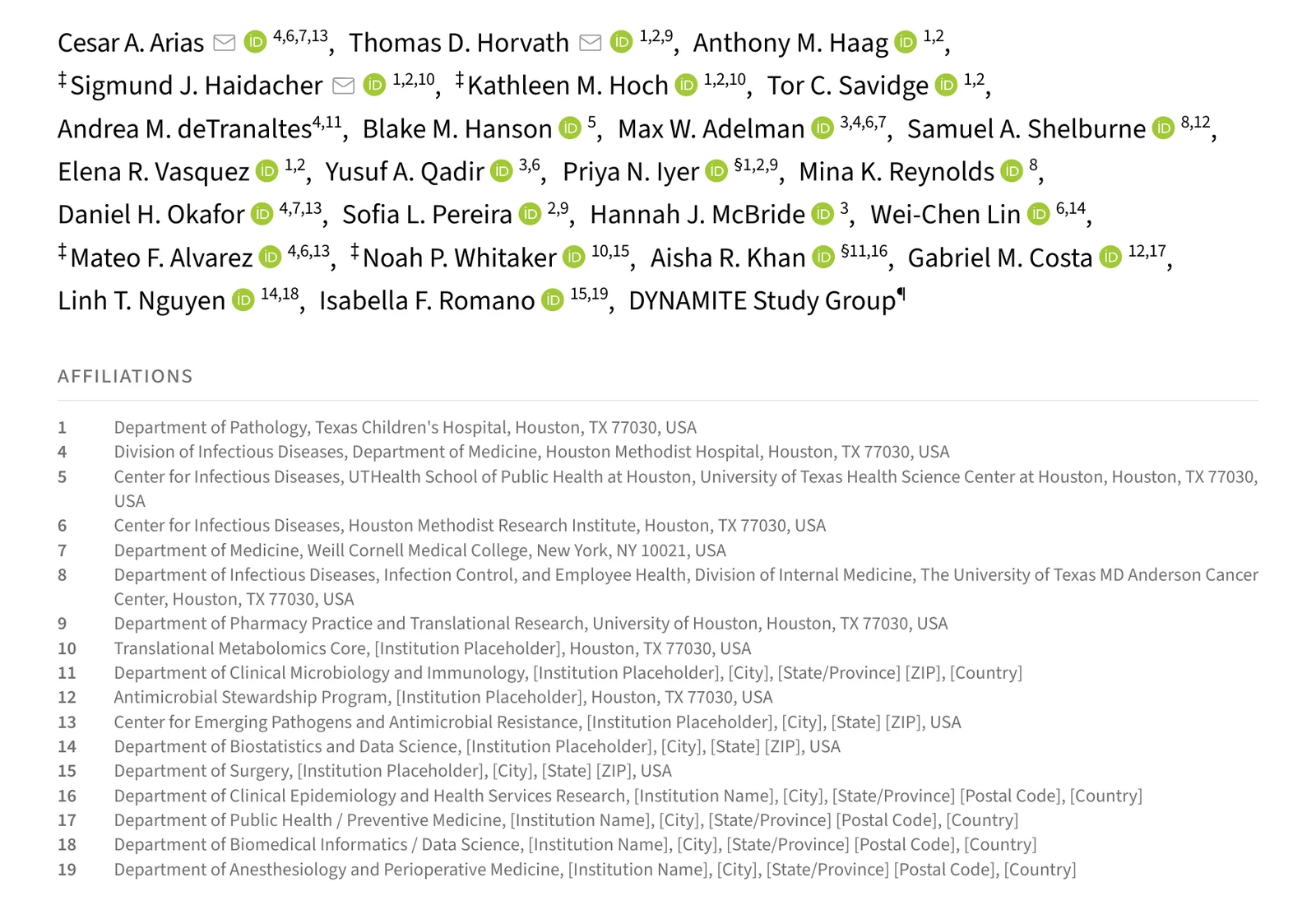
- 04TitleSet in the journal’s identity face.
- 05AuthorsWith ORCID and correspondence marks, numbered to their affiliations.
- 06AffiliationsA numbered list — built for twenty-six authors as much as for two.
- 07Author notesEqual contribution, present addresses.
- 08Non-specialist summaryPlain language before the abstract, on every journal.
- 09AbstractStructured where the journal structures it.
- 10BodyNumbered sections in the reading face.
- 11Running footerJournal, page, volume and date.
The same anatomy, five journals
JMSACLIn production 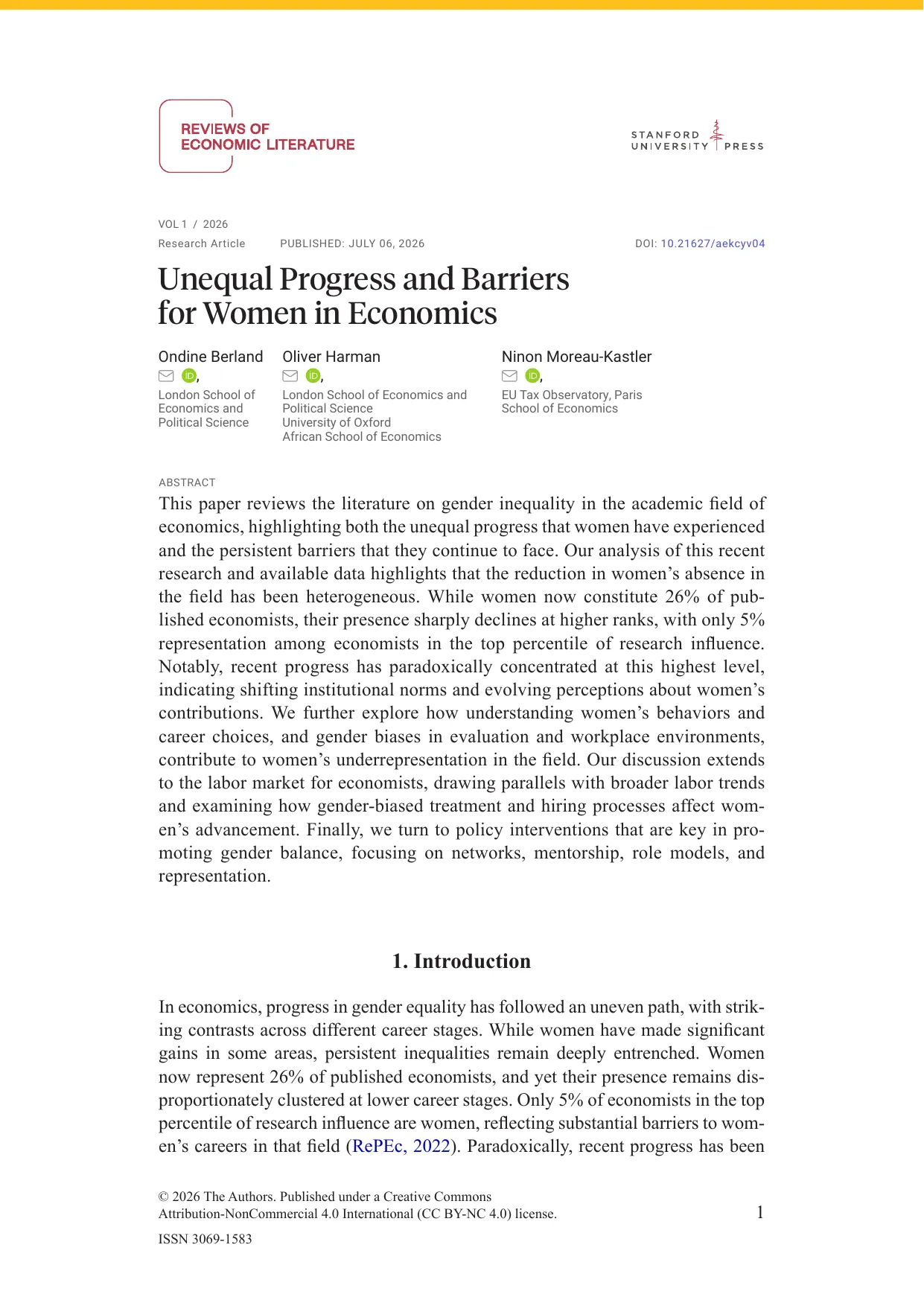
RELIn production 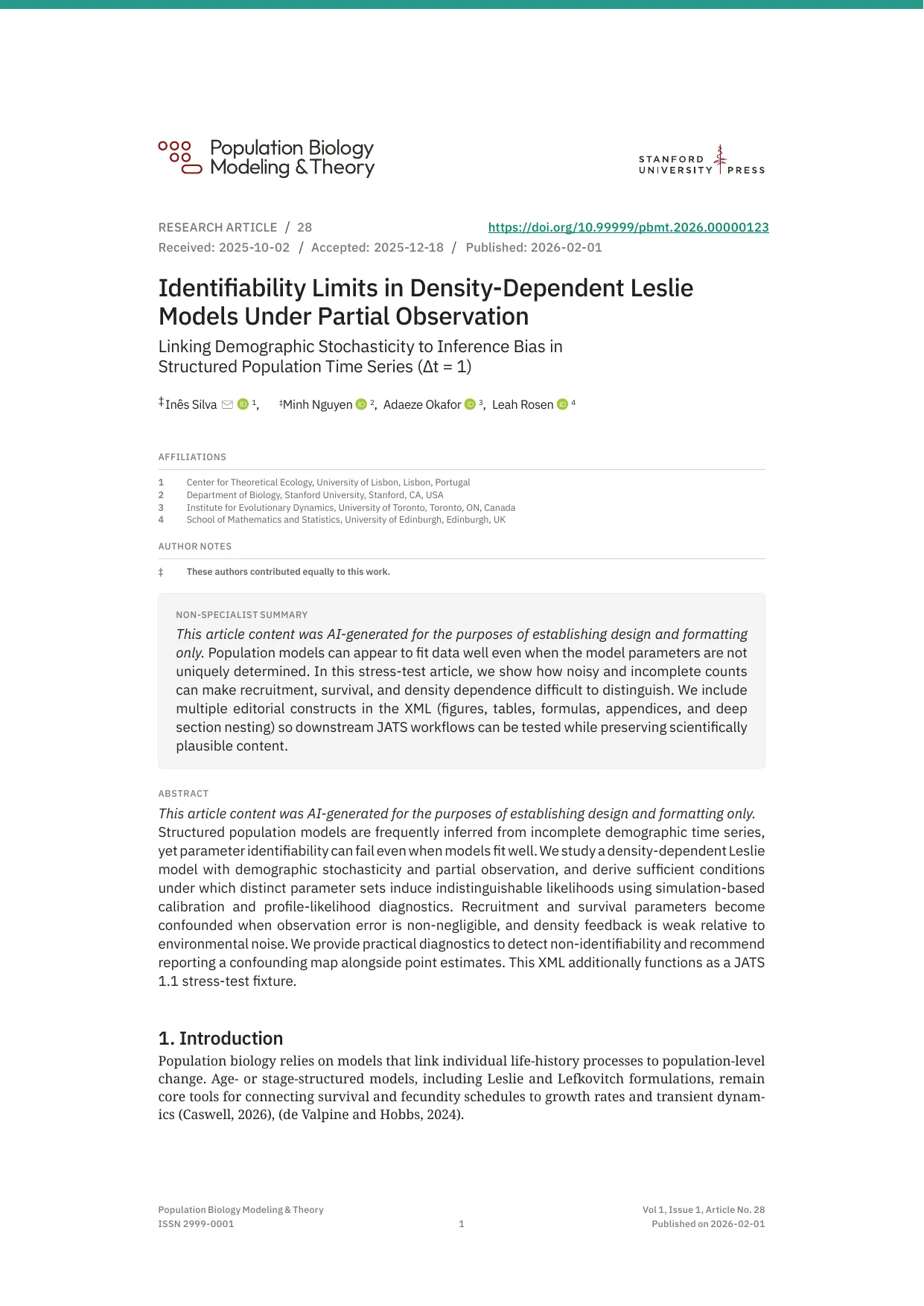
PBMTTemplate 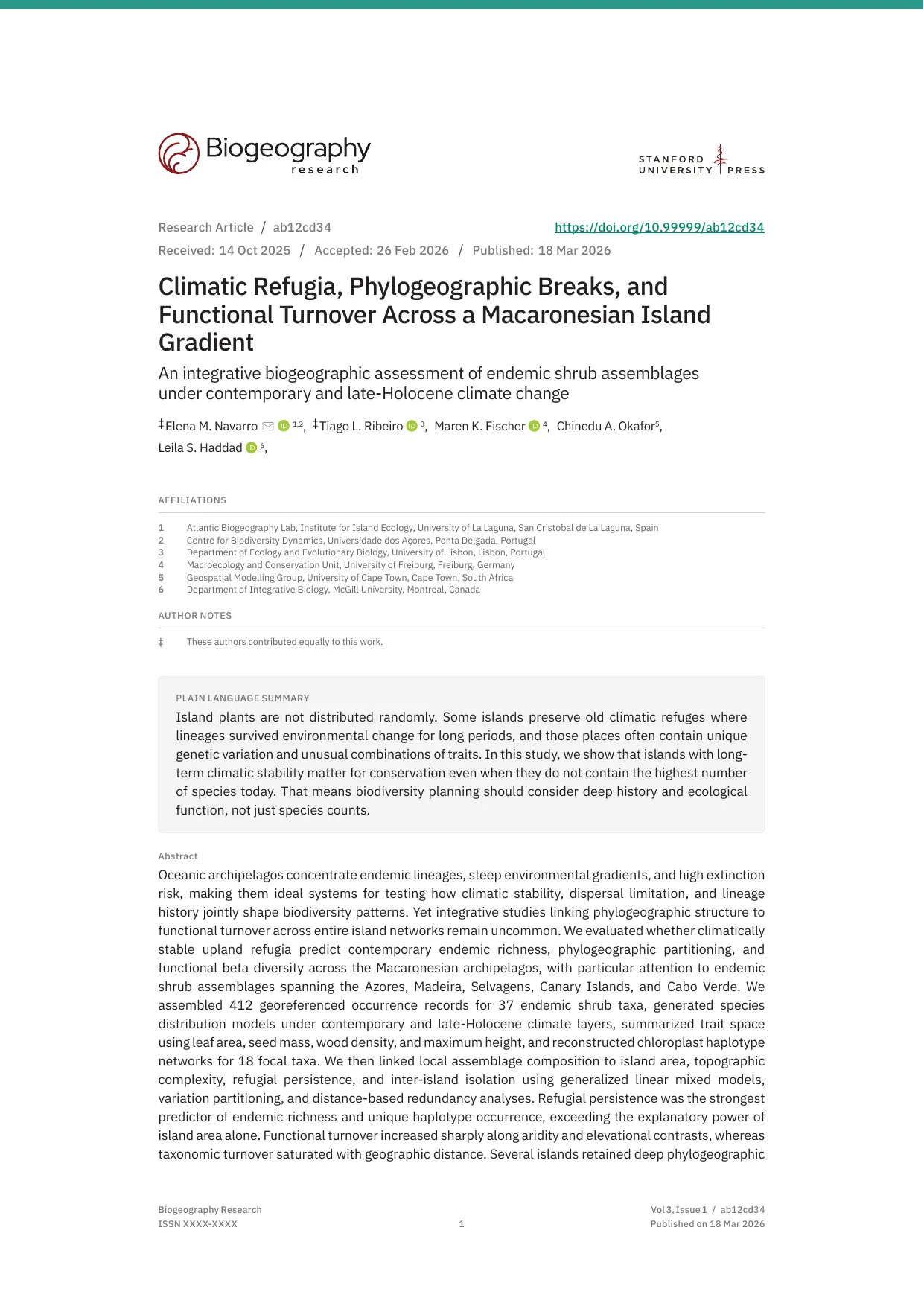
BIOGTemplate 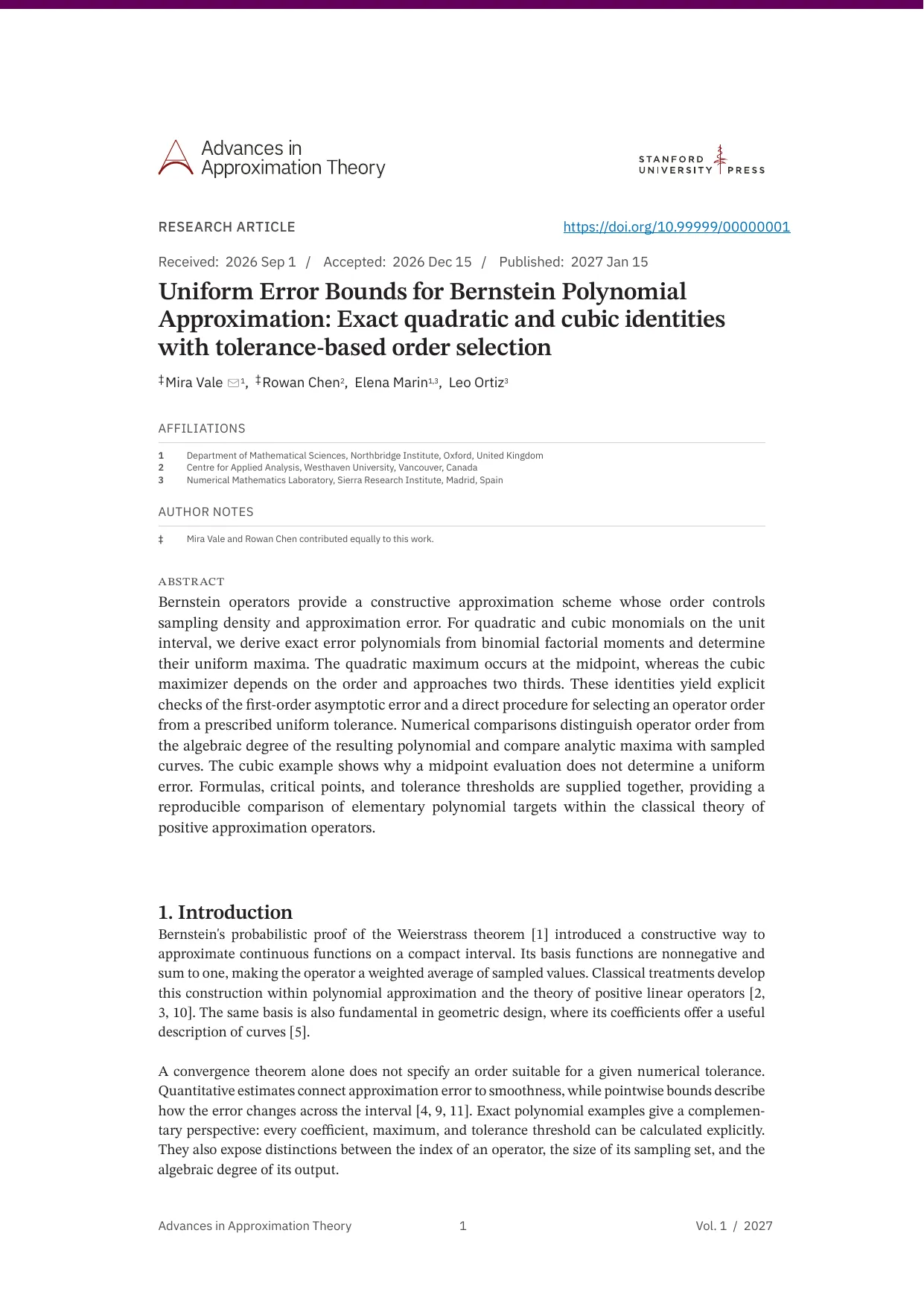
AATTemplate
Pushed past the ordinary article before production
07 / 11 The screen
The same article, reflowed.
The HTML article keeps the anatomy of the page and adds what a screen can do: a contents column that follows the reading, tabs for figures and tables, a side panel for citation, funding, ethics and licence, mathematics that is text, not pictures. It reflows to a phone without losing a module — drag the window’s edge to see it.
08 / 11 The site
One theme, every journal.
The journal site is a theme for Open Journal Systems that a journal manager sets from the back office. These are its real settings, applied the way the theme applies them — to the homepage and an article of two journals on our staging server.
Behind the settings
The theme
- A child theme of the default theme of Open Journal Systems 3.4 — presentation only.
- Sixteen page templates, eleven stylesheets, one token layer for type, spacing, layout and colour roles.
- No journal is hard-coded: every difference is configuration.
The companion plugin
- A masthead per issue, checked before the issue can be published.
- A non-specialist summary, required or optional at submission, journal by journal.
- An editorial team edited as people, not typed as a page. Without the plugin the theme still renders every page.
How it runs
- No file of the platform’s core is changed.
- Theme and plugin ship as versioned releases, installed and upgraded through the platform’s own plugin manager.
- Every switch changes what is drawn, never what is stored. Every typeface ships with the theme.
09 / 11 The source
Structure in, reading out.
One published article, followed from its XML to the pages a reader opens. Scroll through the four steps — or choose one.
<article article-type="research-article"><front><article-meta><article-id pub-id-type="doi">10.21627/kqcara81</article-id><title-group><article-title>Development of a Rapid and SimpleLC-MS/MS Method for the Quantitation of Baricitinibin Human Plasma and Aqueous Humor</article-title></title-group><contrib-group><contrib contrib-type="author"><name><surname>Li</surname><given-names>Xiping</given-names></name></contrib><!-- four more authors --><contrib contrib-type="author" corresp="yes"> … <xref ref-type="corresp" rid="cor2"/></contrib-group><abstract><title>Abstract</title><p><bold>BACKGROUND:</bold> Increasing evidence supports theoff-label use of Janus kinase inhibitors … </p></abstract></article-meta></front><body><sec id="S1"><label>1.</label><title>Introduction</title> … </sec><sec id="S2"> … <sec id="S14"> … <sec id="S24"> …</body><back><ref-list><ref id="b1"><mixed-citation> Takeuchi M, Mizuki N,Ohno S. Pathogenesis of non-infectious uveitis … </ref><!-- 28 more references --></ref-list></back></article>- The identifierDOI present
- The titleArticle title present
- The authorsSix authors named · corresponding author linked
- The abstractAbstract present
- The sectionsSections present · each with an id
- The referencesTwenty-nine references present


Research articlehttps://doi.org/10.21627/kqcara81
Development of a Rapid and Simple LC-MS/MS Method for the Quantitation of Baricitinib in Human Plasma and Aqueous Humor
- 1. Introduction
- 2. Materials and Methods
- 3. Results and Discussion
- 4. Conclusion
Abstract
BACKGROUND: Increasing evidence supports the off-label use of Janus kinase inhibitors for the treatment of noninfectious uveitis. Although several bioanalytical methods for determining baricitinib concentrations have been reported, no methods are currently available for monitoring …
References
- Takeuchi M, Mizuki N, Ohno S. Pathogenesis of non-infectious uveitis elucidated by recent genetic findings. Front Immunol. 2021;12:640473.
- Chen EJ, Bin Ismail MA, Mi H, et al. Ocular autoimmune systemic inflammatory infectious study (OASIS) — report 1 …
- HTML articleGenerated by the transformer from the XML.
- PDF articleTypeset on the journal’s template, in its own workflow.
- Journal siteThe OJS theme presents the issue and its articles. Staging.
01 / 04The article as structure. Every part is named — the identifier, the title, the authors, the abstract, the sections, the references — so it can be read by people and by software alike.
10 / 11 The system
What is shared, what a journal sets.
A new journal is a set of choices, not a new design: the system stays, the identity changes. Accessibility was an input, not a final check — every colour role measured before it became a token, every surface built for a keyboard, a screen reader or a larger text setting.
Shared by every journal
- Anatomy
- Masthead, type and identifier, dates, title, authors, affiliations, summary, abstract — in that order on paper, on screen and on the site.
- Components
- The current issue, article cards, the article landing with its side panel, the editorial team, announcements, archive, search.
- Tokens
- One set of colour and type values that produces the HTML’s styles and the PDF templates’ values alike.
- Transformer
- One JATS XML → HTML transformer; each journal is a configuration it reads, not a copy of it.
- Accessibility
- WCAG 2.2 AA articles; focus never removed; type in rem so it follows the reader’s setting.
Set per journal
- Mark
- Its own symbol, in Stanford red, with the press at the right.
- Colour and type
- One family and one pairing, carried by the site, the HTML article and the PDF alike.
- Labels and references
- Section numbering, labels and reference style, as configuration.
11 / 11 Where things stand
Four journals publishing on it today. A fifth launching in 2027.
- 5journals on one systemJMSACL, REL, PBMT, BIOG and AAT share one foundation for the site, the HTML article and the PDF.
- 4journals publishing on it todayJMSACL, REL, PBMT and BIOG; AAT launches in 2027.
- 1theme for every journalConfigured from the back office, never forked: a new journal is a set of choices.
- AAWCAG 2.2 on the HTML articlesChecked in March 2026.