 Only a
 Type for journals
What it takes for a journal's typography to hold up across decades of scholarship.
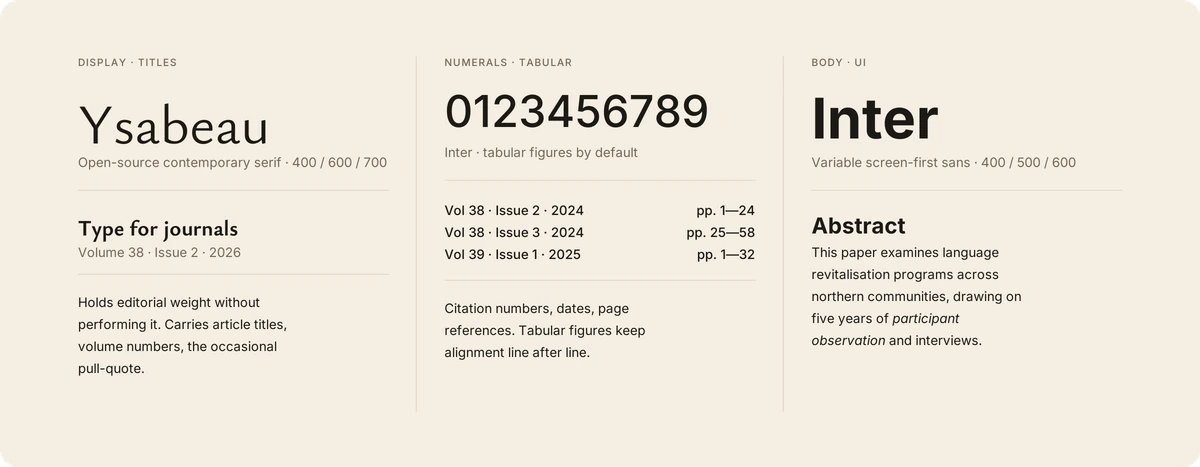
Most journals pick type the way marketing sites do — a display face for the brand, a body face that “feels academic”, and ship.
That’s the wrong order. A journal’s type stack isn’t a brand decision. It’s editorial infrastructure: the thing that carries thirty years of scholarship across screens, scripts, and disciplines that nobody chose the type for in advance.
Here’s what we look at before we pick the first face.
Body type carries the scholarship
Readers spend 90 percent of their time inside an article column. The body face is the only face most readers will consciously notice.
A body face for scholarship needs:
- Legibility at 14–16px on screen. Most readers never zoom. The face has to work at the size it actually gets rendered.
- Tabular numerals. Citation numbers, dates, page references, tables. A face without tabular figures drops in and out of alignment every line.
- Real italics, not slanted Roman. Half of academic prose is references and titles in italics. Faux italics break the rhythm at small sizes.
- Small caps where the discipline needs them. Law journals, classical studies, linguistics — small caps aren’t decorative. They carry meaning.
Inter, IBM Plex, Source Sans, certain humanist serifs (Source Serif, Crimson, Lora) all meet this bar. Most designer-favourite faces don’t.
Display type carries editorial weight, not personality
Display type appears in three places only: article titles, volume and issue numbers, the occasional pull-quote. It’s a smaller surface than designers expect — usually under 5 percent of the type a reader sees.
The decision isn’t “what makes this journal feel distinct”. It’s “what holds up at scale across hundreds of article titles, none of which have been written yet”. Editorial weight, not loudness. Considered, not stylised.
For CJNE — the Canadian Journal of Native Education — we picked Ysabeau for display. It carries authority without performing it, and it pairs with Inter for body without competing.
Scripts the journal will actually publish
This is where most type decisions break down.
Latin-only stacks are fine for many journals. They’re a disaster for the journals we tend to work with — Indigenous education, area studies, linguistics, religious studies. A journal that publishes Algonquian syllabics, Devanagari, Arabic, or CJK can’t ship a typesystem that only handles Latin.
Two practical rules:
- Script coverage should match the journal’s actual publishing history, not a guess about the future. Look at the last ten years of articles.
- Match scripts at the system level, not the article level. A Latin body and a Devanagari body should feel like a coherent pair when an article mixes the two in a single paragraph. Noto’s superfamily handles this. Most others don’t.
Variable fonts, when the budget can carry them
Variable fonts are the right default for new journals. One file, multiple weights and widths, full optical-size axis on the faces that have it.
The catch is licensing. A university press with a 30-year archive may have legacy commitments to specific faces, in static formats, with per-volume licensing that doesn’t survive a switch to variable. The right answer is usually phased: variable for new content, static for archive, body face matched across both so the reader doesn’t notice the seam.
Type is editorial infrastructure
The temptation in a journal redesign is to start where the visual brief points — a colour, a logo, a hero image. We start with type.
If the type stack holds up, the journal can publish issue 4.2 without us, and issue 12.3, and a special issue on a topic the editor hasn’t proposed yet. If it doesn’t, every issue becomes a redesign.
Pick for decades. Document the system. Move on.
NEWSLETTER
Get notified when we publish.
Occasional notes from the studio. No frequency promises, no marketing — just the writing, when it ships.